Saudi Arabia Residential Battery Storage Market Size, Share, and Forecast 2026-2034

IMARC Group, a leading global market research and management consulting firm, has published its latest market intelligence report on the Saudi Arabia Residential Battery Storage Market. The Saudi Arabia residential battery storage market size reached USD 89.3 Million in 2025 and is projected to reach USD 404.6 Million by 2034, exhibiting a CAGR of 18.28% during 2026-2034. Growth is being driven by rising household energy costs amid subsidy reforms, mounting grid strain from extreme cooling demand, rapid pairing of rooftop solar with home battery systems, and government-backed regulatory clarity around distributed energy resources.
Residential battery storage is emerging as a practical response to some of Saudi Arabia's most pressing energy realities, from the removal of electricity subsidies that has exposed households to the true cost of power, to a punishing desert climate that places heavy strain on the national grid during peak cooling months. As Saudi authorities push ahead with Vision 2030's renewable energy and storage targets, decentralized residential solutions are gaining institutional attention alongside the Kingdom's headline utility-scale battery programs. At the same time, regulatory entities are formalizing interconnection standards for distributed storage, unlocking supplier confidence and installer networks. Combined with falling battery costs, growing solar-plus-storage adoption in new residential developments, and rising consumer awareness of grid resilience, these forces are reshaping the competitive landscape and setting the stage for durable, long-term growth across the Kingdom.
Saudi Arabia Residential Battery Storage Market at a Glance:
Market Size (2025): USD 89.3 Million
Market Forecast (2034): USD 404.6 Million
Growth Rate (2026-2034): CAGR of 18.28%
Base Year: 2025 | Historical Period: 2020-2025 | Forecast Period: 2026-2034
Leading Battery Type Segment: Lithium-ion Batteries, supported by higher energy density, longer cycle life, and better suitability for extreme desert temperatures
Leading Application: Solar Energy Storage, as rooftop PV and battery pairing becomes the default configuration for new residential installs
How AI is Reshaping the Future of the Saudi Arabia Residential Battery Storage Market
AI-Driven Smart Metering and Grid Intelligence: The Saudi Electricity Company signed a strategic cooperation agreement with technology firm Abjay in December 2025 to deploy AI-driven analytics across its smart metering network, strengthening predictive analysis and data-driven decision-making, a foundation that increasingly shapes how residential storage systems interact with the grid.
AI-Powered Home Energy Optimization: Smart home energy platforms such as Huawei's FusionSolar are applying AI to residential solar-plus-storage setups, using real-time price and weather prediction to automatically optimize when a home battery charges and discharges, with the platform reporting over 20,000 AI-powered homes globally as of September 2025.
AI for Demand-Side Management: Saudi utilities are increasingly using AI-enabled smart meters and connected devices to learn household consumption behavior and adjust it dynamically, including determining optimal battery charge and discharge timing to maintain grid stability during peak cooling-driven demand hours.
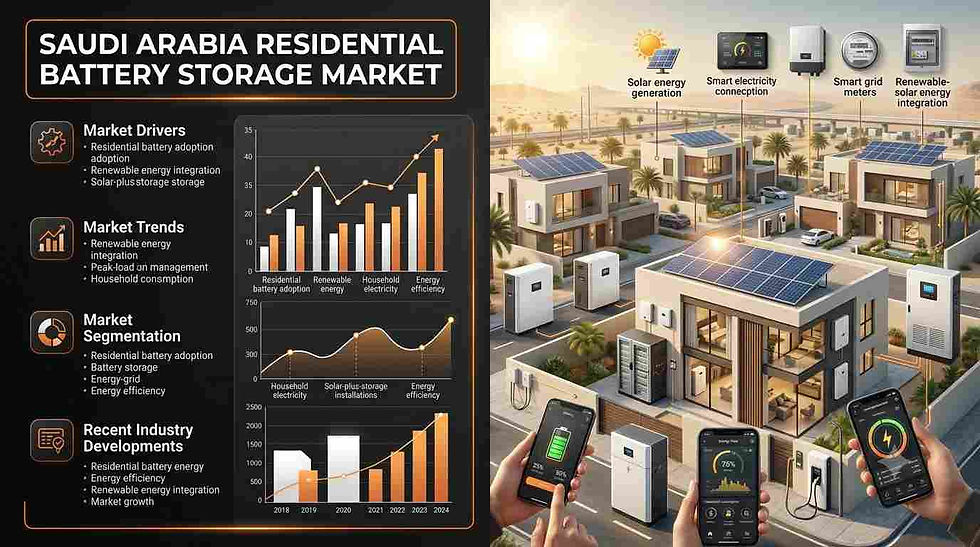
Grab a sample PDF of this report: https://www.imarcgroup.com/saudi-arabia-residential-battery-storage-market/requestsample
Saudi Arabia Residential Battery Storage Market Trends and Drivers:
The core driver of the market remains the removal of electricity subsidies, which has exposed households to the true cost of power and pushed a growing share of consumers toward technologies that reduce monthly bills and buffer against tariff volatility. Rising cooling demand during extended summer heatwaves continues to strain the grid, and residential battery systems are increasingly valued for their ability to keep homes powered through voltage instability and localized outages, particularly in dense urban districts and in households with elderly residents or energy-intensive appliances.
The region's structural differentiator is its harsh desert climate: sandstorms and dust reduce solar panel efficiency and make output unpredictable, so batteries play an outsized role in smoothing supply and making rooftop solar genuinely useful across the full day rather than only during peak sunlight hours. This dynamic is prompting newer residential developments built under sustainability guidelines to integrate storage into the design phase from the outset rather than retrofitting it later.
A third driver is the deepening alignment between residential energy policy and national Vision 2030 targets. The Kingdom's plan to source 50% of electricity from renewables and its 48 GWh storage deployment target by 2030 are being reinforced by utility-scale build-own-operate battery tenders that are steadily building out local supply chains, financing structures, and installer expertise, a dynamic that is set to intensify over the coming decade.
Government Schemes and Vision 2030 Initiatives Driving Demand:
WERA and Ministry of Energy Interconnection Standards: Saudi Arabia's Water and Electricity Regulatory Authority and Ministry of Energy are implementing clear technical standards and interconnection rules for distributed energy systems, including residential battery storage, gradually increasing confidence among suppliers, installers, and consumers.
Vision 2030 Renewable Energy and Storage Targets: The Kingdom's Vision 2030 plan targets sourcing 50% of electricity from renewables and deploying 48 GWh of battery storage capacity by 2030, with grid-scale programs increasingly expected to spill over into residential-grade technology adoption and pricing.
SEC-Led Grid-Scale BESS Build-Out: In January 2026, the Saudi Electricity Company completed grid connection of a 7.8 GWh battery energy storage system across three sites in south-western Saudi Arabia, a milestone in national power system modernization that is building the country's broader storage supply ecosystem.
K.A.CARE-Backed Residential Pilot Programs: Pilot residential battery programs supported by the King Abdullah City for Atomic and Renewable Energy reflect growing institutional interest in small-scale storage applications, complementing the Kingdom's focus on utility-scale projects.
SPPC Build-Own-Operate Storage Tenders: The Saudi Power Procurement Company has run successive rounds of battery storage tenders, including a 2026 qualification round covering six projects totaling 3 GW and 12 GWh, part of a broader plan to procure up to 10 GW of battery energy storage capacity by 2030.
Saudi Arabia Residential Battery Storage Market Industry Segmentation:
The report has segmented the market into the following categories:
Breakup By Battery Type:
Lithium-ion Batteries
Lead-acid Batteries
Others
Lithium-ion batteries lead the type segment, favored for their higher energy density, longer cycle life, and better suitability to the Kingdom's extreme desert temperatures compared to legacy lead-acid systems.
Breakup By Capacity:
Below 5 kWh
5-10 kWh
10-20 kWh
Above 20 kWh
Mid-range capacity systems in the 5-10 kWh band see the strongest residential uptake, sized to cover typical household backup needs and solar self-consumption without the higher upfront cost of larger systems.
Breakup By Ownership Model:
Customer-owned Systems
Third-party Owned/Leasing Models
Customer-owned systems remain dominant, though third-party leasing and financing models are gaining traction as installers look to lower the upfront cost barrier for mainstream households.
Breakup By Sales Channel:
Direct Sales
Distributors/Dealers
Online Retail
Distributors and dealers lead the sales channel segment, reflecting the continued importance of certified installers for a product category that requires technical setup and interconnection approval.
Breakup By Application:
Backup Power Supply
Solar Energy Storage
Off-grid Systems
Others
Solar energy storage is the leading application, as rooftop PV and battery pairing increasingly becomes the standard configuration for new residential installations rather than a standalone backup product.
Breakup By Region:
Northern and Central Region
Western Region
Eastern Region
Southern Region
The Northern and Central Region, anchored by Riyadh's dense residential construction pipeline, holds the largest share, supported by strong urban demand and proximity to national grid infrastructure investment.
Competitive Landscape:
The Saudi Arabia residential battery storage market features a mix of global solar and storage technology suppliers active across the Kingdom, alongside local installers and distributors building out residential-focused offerings. Key players include:
Tesla
Huawei
Sungrow
BYD
Growatt
SolaX Power
Global suppliers such as Huawei and Sungrow have expanded their footprint in the Kingdom through utility and commercial storage deployments, positioning them well to extend into residential-grade systems as local demand scales, while smaller regional distributors compete on installation service, financing flexibility, and desert-optimized product durability.
Market Concentration Analysis:
The residential battery storage market remains fragmented at the brand level, with global suppliers such as Huawei, Sungrow, BYD, Tesla, Growatt, and SolaX Power competing through local distributors and certified installers rather than direct, vertically integrated retail presence.
Unlike the utility-scale segment, where state-backed entities such as the Saudi Electricity Company and Saudi Power Procurement Company anchor large build-own-operate projects, no single domestic manufacturer currently dominates residential-grade production, with demand served largely through imported systems paired with local solar EPC and installation firms.
Competitive intensity is expected to rise as domestic manufacturing capacity being built in the Kingdom, including facilities such as the ZOE Energy Storage joint venture targeting 6 GWh by 2027, gradually creates a local supply base that could shift residential-grade sourcing toward domestic production and tighten competition on price and after-sales service.
What Does The Full Report Cover?
Historical, current, and forecast market size for the Saudi Arabia residential battery storage market from 2020 to 2034
Market breakup by battery type, capacity, ownership model, sales channel, application, and region
Regional analysis covering the Northern and Central, Western, Eastern, and Southern regions
Key growth drivers, restraints, and opportunities shaping the market
Porter's Five Forces analysis and value chain assessment
Competitive landscape, market structure, and player positioning
Detailed profiles of major regional and international battery storage suppliers
Recent News and Developments in the Saudi Arabia Residential Battery Storage Market
January 2026: The Saudi Electricity Company completed grid connection of a 7.8 GWh battery energy storage system across three sites in south-western Saudi Arabia, marking a major milestone in the country's power system modernization.
April 2026: The Saudi Power Procurement Company began preparing to tender a further phase of battery storage capacity as part of plans to procure up to 10 GW of battery energy storage system capacity by 2030.
May 2026: ZOE Energy Storage partnered with a Saudi company to establish a battery energy storage system manufacturing facility, with Phase I targeting 6 GWh of capacity by the first quarter of 2027, supporting the Kingdom's broader storage supply chain.
July 2026: Saudi Arabia prequalified 27 companies to bid for a second round of utility-scale battery storage projects totaling 3 GW and 12 GWh, advancing renewable energy goals under Vision 2030.
August 2026: Saudi Arabia awarded contracts for four battery energy storage projects with combined capacity of 2,000 megawatts and a total investment of USD 1.2 billion, supervised by the Ministry of Energy under the build-own-operate model.
Note: If you require specific details, data, or insights that are not currently included in the scope of this report, we are happy to accommodate your request. As part of our customization service, we will gather and provide the additional information you need, tailored to your specific requirements. Please let us know your exact needs, and we will ensure the report is updated accordingly to meet your expectations.
Key Questions This Report Answers
How has the Saudi Arabia residential battery storage market performed so far and how will it perform in the coming years?
What are the key growth drivers, restraints, and opportunities in the Saudi Arabia residential battery storage market?
What is the breakup of the market by battery type, capacity, ownership model, sales channel, and application?
Which region leads the Saudi Arabia residential battery storage market, and why?
How are government schemes and Vision 2030 programs shaping regional storage demand?
Who are the key players in the Saudi Arabia residential battery storage market, and how is the competitive landscape evolving?
What role is AI and digitization playing in the future of residential battery storage in Saudi Arabia?
About Us
IMARC Group is a global management consulting firm that helps the world's most ambitious changemakers to create a lasting impact. The company provides a comprehensive suite of market entry and expansion services. IMARC offerings include thorough market assessment, feasibility studies, company incorporation assistance, factory setup support, regulatory approvals and licensing navigation, branding, marketing and sales strategies, competitive landscape and benchmarking analyses, pricing and cost research, and procurement research.
Media and Sales Contact
IMARC Group
Email: sales@imarcgroup.com
United States: +1-201-971-6302
India: +91-120-433-0800
United Kingdom: +44-753-714-6104


Comments